
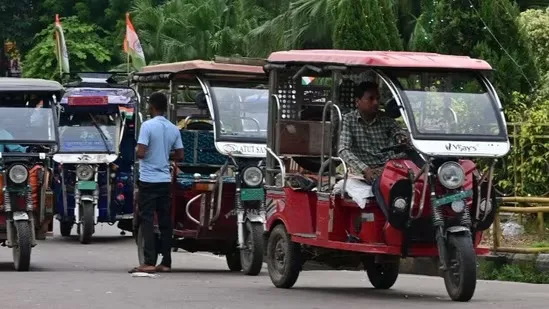
The Chinese App Behind Viral E-Rickshaw Shutdown Videos: How It Works, and How to Prevent It
A strange new trend has taken over Indian social media in the past few days. Videos of e-rickshaw drivers suddenly losing power mid-ride, stranded in the middle of traffic, have been flooding Instagram, YouTube, X and Reddit. The reason turns out to be a Chinese battery-management app called BAT-BMS, which some users have figured out how to misuse against unsuspecting drivers.
What's actually happening
In the viral clips, a person walks up to a moving or parked e-rickshaw — locally called a "tirri" — opens the BAT-BMS app on their phone, connects to the vehicle's battery over Bluetooth, and flips what's called the discharge switch. Within moments, the vehicle loses power and the driver is left confused and stranded. Some creators have framed it as payback for reckless e-rickshaw driving, with one caption reportedly reading that drivers "have caused enough trouble" and it's now "time for revenge." Other clips, to be fair, show bystanders stepping in to help affected drivers get their vehicles running again.
For the drivers themselves, none of this feels like a joke. Several videos show operators stuck mid-route, unable to restart their rickshaws, with some paying strangers between Rs 100 and 200 just to get the battery switched back on. Many don't own smartphones or have the technical know-how to fix the problem themselves, so they end up relying on passersby — occasionally the very people who caused the shutdown in the first place. For someone whose daily income depends on how many trips they complete, even a short forced stop can mean a real dent in earnings.
So how does the app actually work?
BAT-BMS isn't some hacking tool built for mischief. It was developed by the Chinese firm Shenzhen Grenergy Technology as a legitimate tool for managing Bluetooth-enabled lithium battery packs, originally intended for use in solar, marine and off-grid power systems — not vehicles. Within a range of roughly 10 to 15 metres, it lets a user monitor a battery's voltage, current, temperature, charge cycles and overall health — and, crucially, it also allows the discharge function to be switched on or off remotely.
The problem lies in how loosely this capability has been implemented in the Indian EV market. A large number of budget e-rickshaws and electric scooters sold in India run on Chinese-made Battery Management Systems that come with little to no security — often with Bluetooth left open by default, meaning nearby phones can pair with them without needing any password or authentication. So anyone standing close enough with the app open can, in theory, connect to a vulnerable battery and cut its power
That said, it's worth pushing back on the more alarmist framing of this trend. According to a fact-check by The Lallantop, cited by India TV News, the app can't simply latch onto any random e-rickshaw passing by — connecting requires a unique ID tied to that specific battery, so without that identifier, the app has no way of randomly grabbing control of nearby vehicles. Reports have also pointed out that the risk isn't universal at all — a large share of e-rickshaws in India still run on older lead-acid batteries that have no Bluetooth capability whatsoever, and even among lithium-powered ones, many use proprietary software that simply won't talk to a third-party app like BAT-BMS. Some users who tried recreating the viral clips themselves reportedly found that it isn't as effortless as it looks on camera — it generally requires being stationary, staying close to the vehicle, and getting lucky enough to find a battery that's both compatible and unsecured
Where things stand officially
As of now, the app is still available on the Google Play Store, though it has reportedly been pulled from Apple's App Store following the backlash. Government scrutiny appears to be starting too — the Ministry of Electronics and Information Technology (MeitY) is reportedly examining the security implications of the app after the wave of shutdown videos raised questions about passenger safety and the state of security in connected battery systems used in low-cost EVs. Cybersecurity professionals are urging people not to write this off as just another internet prank. As one industry executive put it in comments to Business Standard, when a safety-critical system like a battery management unit can be accessed over Bluetooth without proper authentication, the real worry isn't the app itself — it's that vehicle systems are being connected to the internet faster than the security thinking behind them
How drivers and owners can protect themselves
Since the vulnerability comes down to open, unsecured Bluetooth pairing rather than any deep flaw in the app, the fixes are fairly practical:
- Check with your battery/vehicle dealer whether the BMS fitted in your e-rickshaw supports password-protected or PIN-based pairing, and if so, get it enabled immediately instead of leaving it on factory-default settings.
- Ask about firmware updates. Some manufacturers have started pushing updates that close this open-pairing gap — it's worth asking your dealer or the battery brand directly.
- Turn off Bluetooth on the battery pack when it isn't needed, if the unit allows manual toggling, so it isn't discoverable to just anyone in range.
- Report suspicious activity. If a rickshaw shuts down unexpectedly and a bystander is seen with a phone nearby, it's worth flagging to local police, especially as authorities begin looking into the misuse more seriously.
- Associations and dealers should push suppliers for battery systems with proper authentication built in by default, rather than leaving basic security as an optional extra
Read Also :- Rivers on Alert! Rudraprayag Faces Flood Threat as IMD Warns